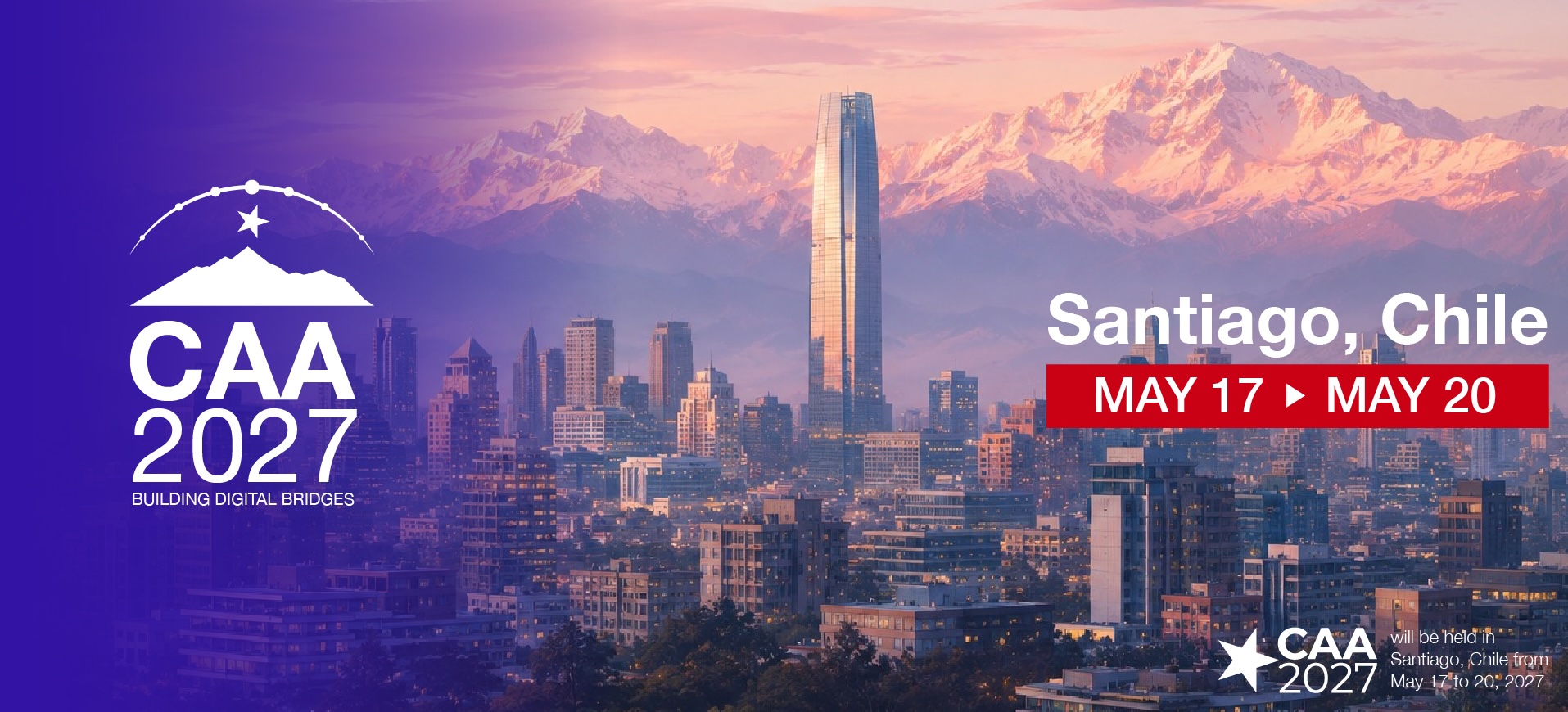
You are invited to submit an abstract for a paper or poster on any aspect of computer applications or quantitative methods in archaeology for presentation at CAA’s 54th conference to be held in Santiago, Chile.
Submission period closed 16 October 2026.
Authors of papers and posters will select from 35 sessions being organised.
Each session will follow one of the following formats:
- Standard – with a series of formal papers (normally 10-20 minutes in length + time for questions) addressing a theme presented in advance by the organisers. The precise duration of the talks varies from session to session and will be communicated to speakers by the session chairs.
- Round Table – with a pre-conference position paper published by the organisers, followed by an invitation for researchers to submit a response in advance or to participate in open-forum discussion at the session. Please see the round table page for the abstracts and additional information.
- Other – with the format decided by the organisers, exploring innovative and creative ways for participants to engage with the session.
Please check the format of each session carefully before submitting an abstract and see the guidelines below to learn more about the different requirements for each type.
If your presentation is applicable to more than one session, please indicate that during the submission process by selecting the one that best matches the topic of your paper as your primary subject area and up to four other related sessions as secondary options. If none of the sessions are appropriate for your paper, please mark the closest fit as your primary choice and then the “Advances in Computational Archaeology” as a secondary option.
Abstracts for posters should only be submitted to the poster session. Authors will be invited to make an optional short presentation about their poster during the session.
Please note that CAA conferences are running a double-blind review process, therefore authors’ affiliation and/or any information within the text that may indicate who the author(s) should be omitted from the submission.
Submissions from Student and Early Career Researchers
Papers and posters from Students and Early Career Researchers are actively encouraged.
The Nick Ryan Bursary will be awarded to the best student paper at CAA2027 and the recipient will receive a bursary of up to € 1,000 to travel to the CAA2028 conference.
Students who wish to be considered for the Nick Ryan Bursary should review the guidelines and then check yes to question 2 when submitting their abstract to a standard/other format session.
The CAA International Scientific Committee will shortlist the top student papers for participation in the Nick Ryan Bursary session during the abstract review process. Shortlisted authors will be asked to record and submit a video of their paper presentation approximately two to three weeks before the conference. During the conference, all Nick Ryan Bursary participants will present their papers in-person in the session for which they were accepted. The winner of the Nick Ryan Bursary award will be announced at the Annual General Meeting (AGM).
Recycle Award
Papers using legacy data can apply to the CAA Recycle Award, during the abstract submission process. More details on the conditions for applying to the award can be found here.
Submitting an Abstract
To submit your abstract please go to Conference Management Toolkit (CMT)1 (You will need to create an account if you have not previously submitted a proposal in CMT). Please review and follow the guidelines for authorsbelow:
Note that this year, the abstract must be submitted as a PDF file. Filling the “abstract” field in the form is not enough.
Individuals may only be the first named author on one standard paper or other format session requiring a full paper. Round tables, posters, lightning talks or similar short presentations are excluded from this limit.
Abstracts should be broad enough to reach all interested researchers, regardless of affiliation or background. The official language of the conference is English, and all abstracts should be submitted in English. You will be required to endorse the CAA ethics statement as part of your submission.
The CAA2027 Call for Papers and Posters has closed 16 October 2026. Any technical queries related to the CAA2027 submission system should be addressed to the chair of the scientific committee (SciComm_Chair@caa-international.org) or the acting conference officer (kelsey.pennanen1@ucalgary.ca). Any questions about the conference organisation or other logistical queries should be directed to 2027@caaconference.org. Any queries related to the scientific or review process should be sent to the scientific committee at: SciComm_Chair@caa-international.org
CAA membership is not required to submit a proposal. However, all conference attendees, including speakers, will need to be a 2027 member prior to registering. 2027 memberships will be available starting around 1 January 2027. For additional information about CAA’s fees and categories, please visit the Membership page.
Session Formats
1. Standard/Other Sessions
Extended abstracts (300 words mínimum, 1200 words maximum, plus up to 5 bibliographic references) will be required for papers submitted to standard sessions. The content of your abstract should be appropriate for the nature of the paper you intend to present.
For standard and other scientific papers, your abstract should include:
- Introduction – an overview of the background to your research and the research questions that will be addressed by your paper;
- Methods and materials – a summary of the sources of data used and the methods employed in your research;
- Results – a description of the results of your research;
- Discussion – a discussion of the wider implications of your research;
- References – up to 5 citations (cited using the Chicago Manual of Style 17th Edition Author Date format, see below).
For discursive or theoretical papers, your abstract should include:
- Context – an overview of the current state of the art and the problems that will be addressed by your paper;
- Main argument – a summary of the key points in your argument;
- Applications or implications – a discussion of the wider implications of your paper for computer applications and quantitative methods in archaeology;
- References – up to 3 citations (cited using the Chicago Manual of Style 17th Edition Author Date format, see below).
For software papers, your abstract should include:
- Introduction – goals of the software/script & how it differs from existing solutions
- Implementation details – technical details about the script/software, algorithms/methods/packages used, etc.
- Usage –how to use the script/software; availability [GitHub, Zenodo, …]; licence
- Case studies – if any
- Discussion
- References
Abstracts should contain sufficient information to allow the CAA Scientific Committee to evaluate the scientific content of your paper. You may include a single figure (see below) that shows the key results or main argument of your paper.
Lightning talks or similar contributions are excluded from the limit of one paper per first named author, i.e. a participant can submit an abstract for both a lightning talk and a 20-minute paper. Participants in other session formats will still have the opportunity to submit a paper for inclusion in the conference proceedings.
2. Round Tables
Round table sessions offer a more interactive format, and organisers are expected to nominate participants by the deadline for the Call for Papers. Nominated panelists do not need to submit abstracts through CMT. If you are interested in being a speaker in one of the accepted round table sessions, please email the chair using the email address listed on the abstract to discuss your potential contributions.
3. Posters
Abstracts (200-500 words, plus up to 3 citations) will be required for posters. Your abstract should include:
- Subject – a description of the methods used and key results (scientific posters), or main argument (discursive or theoretical posters);
- Background – a summary of the topic or research question addressed by the poster;
- Discussion – a discussion of the wider implications of your research for computer applications and quantitative methods in archaeology;
- References – up to 3 citations (cited using the Chicago Manual of Style 17th Edition Author Date format, see below).
Your abstract should contain sufficient information to allow the CAA Scientific Committee to evaluate the scientific content of your poster. You may include a single figure (see below) that shows the key results or main argument of your paper.
Accepted posters will be displayed during the conference. Posters should be only submitted to the dedicated poster Session 36 on the Conference Management Toolkit.
Citations and Figures
Citations
Citations should use the Chicago Manual of Style 17th Edition Author Date style. It is recommended that you use a citation manager. Style files can be either installed directly from within your citation manager or downloaded from:
If you do not use a citation manager, please make sure you carefully follow the examples for the Chicago Manual of Style 17th Edition Author Date style from the Citation Quick Guide.
Figures
A single figure (optional) that shows the key results or main argument of your paper can be submitted with your abstract. Figures should be submitted in a format that can be displayed in a standard web browser and should have a minimum resolution of 300 DPI.
Session Descriptions
Call for Papers, including session descriptions
- “The Microsoft CMT service was used for managing the peer-reviewing process for this conference. This service was provided for free by Microsoft and they bore all expenses, including costs for Azure cloud services as well as for software development and support.” ↩︎